Renaissance Art Characteristics Explained
renaissance art characteristics explained

Renaissance Art Characteristics Explained

Dive deep into the defining features that shaped one of history's most influential artistic movements and its lasting legacy.

Explore the Masterpieces

Key Takeaways

  • ✓ Renaissance art emerged in Italy around the 14th century, marking a rebirth of classical ideals.
  • ✓ Humanism, a focus on human potential and achievement, was a central philosophical underpinning.
  • ✓ Linear perspective, developed by Brunelleschi, revolutionized the depiction of space and depth.
  • ✓ Chiaroscuro and Sfumato were innovative techniques used to create dramatic light and shadow effects.

How It Works

1
Understand the Historical Context

The Renaissance followed the Middle Ages, driven by a renewed interest in classical Greek and Roman culture. This era fostered intellectual curiosity and a shift from purely theological concerns to human experience.

2
Identify Core Principles

Look for elements like humanism, realism, naturalism, and the innovative use of perspective. These principles were not just stylistic choices but reflections of a changing worldview.

3
Recognize Key Artistic Techniques

Familiarize yourself with techniques such as linear perspective, chiaroscuro, sfumato, and contrapposto. These methods allowed artists to achieve unprecedented levels of realism and emotional depth.

4
Analyze Iconic Works

Study famous examples from masters like Leonardo da Vinci, Michelangelo, and Raphael. Observing how these characteristics manifest in their works provides the deepest understanding.

The Dawn of Humanism: A Central Renaissance Art Principle
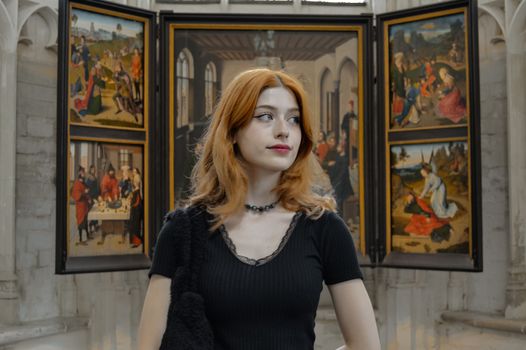
Young woman with red hair stands in art museum, surrounded by historical paintings. Photo: Neda Kekil / Pexels
The Renaissance, literally meaning 'rebirth,' was a profound period of cultural, artistic, political, and economic flourishing that began in Italy during the late Middle Ages and later spread to the rest of Europe. At its philosophical core lay humanism, a movement that profoundly shifted the focus from the divine to the human. Unlike the preceding medieval period, where art was predominantly symbolic and served didactic religious purposes, Renaissance art began to celebrate human potential, achievement, and the beauty of the human form. This wasn't a rejection of religion, but rather an integration of classical ideals with Christian theology, creating a harmonious blend where man was seen as God's greatest creation, capable of reason, virtue, and artistic expression. Artists like Leonardo da Vinci, in his iconic 'Vitruvian Man,' perfectly encapsulated this humanist ideal, depicting man as the measure of all things, perfectly proportioned and symmetrical, reflecting a divine order. The emphasis on individual accomplishment and the dignity of man led to a surge in portraiture, moving beyond generic representations to capture the unique essence and personality of the sitter. Patrons, both religious and secular, commissioned works that glorified their status and legacy, further fueling this humanist trend. The rediscovery of classical texts from ancient Greece and Rome provided a rich source of inspiration, offering models of intellectual inquiry, civic virtue, and artistic excellence. Philosophers and artists alike immersed themselves in these classical works, seeking to emulate their aesthetic and intellectual rigor. This embrace of antiquity was not mere imitation but a creative reinterpretation, adapting classical forms to new contexts and imbuing them with contemporary meaning. The nude figure, largely absent or highly stylized in medieval art, made a powerful return, celebrated for its anatomical perfection and symbolic resonance with classical ideals of beauty and heroism. Michelangelo's 'David' stands as a quintessential example, a monumental sculpture that embodies strength, contemplation, and the triumph of human will, all rendered with an unparalleled understanding of human anatomy. The humanist principle thus laid the groundwork for many of the stylistic innovations that would come to define Renaissance art, shifting the artistic gaze from an exclusively spiritual realm to one that encompassed the vast and complex spectrum of human experience. This intellectual awakening profoundly influenced not only art but also literature, science, and politics, making humanism a cornerstone of this transformative era. For a deeper dive into the broader cultural shifts of this period, consider exploring the impact of the Renaissance on European art history more generally.

Mastering Realism and Perspective: Revolutionary Artistic Techniques
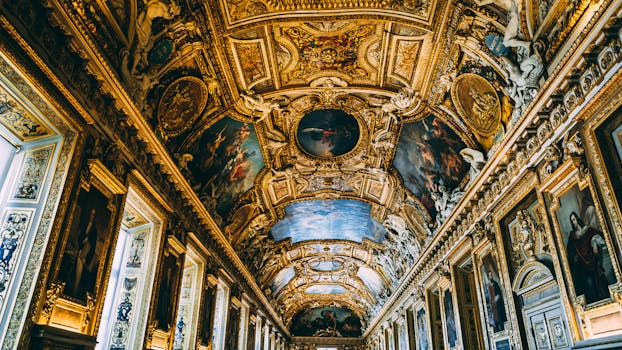
Baroque-style intricate ceiling in a richly decorated hallway, showcasing classic European art. Photo: Chait Goli / Pexels
One of the most groundbreaking and enduring characteristics of Renaissance art was its relentless pursuit of realism and naturalism, coupled with revolutionary techniques to achieve these effects. Artists moved away from the flat, two-dimensional representations of the medieval era towards a more lifelike depiction of the world, reflecting what the human eye actually perceives. This quest for verisimilitude was driven by careful observation of nature, human anatomy, and the principles of light and shadow. The development of linear perspective stands out as perhaps the single most important artistic innovation of the early Renaissance. Credited to Filippo Brunelleschi, and later theorized by Leon Battista Alberti, linear perspective provided artists with a mathematical system to create the illusion of three-dimensional space on a two-dimensional surface. By establishing a vanishing point on the horizon line and drawing orthogonal lines receding towards it, artists could accurately render depth, distance, and proportional relationships between objects within a scene. Masaccio's 'Holy Trinity' in Santa Maria Novella is an early and stunning example, where the architectural setting appears to recede deeply into the wall, creating an incredibly convincing sense of space. This wasn't merely a trick; it fundamentally changed how artists conceived of and constructed their compositions, allowing for narratives to unfold in believable environments. Beyond linear perspective, artists developed and refined other techniques to enhance realism. Chiaroscuro, the use of strong contrasts between light and dark, usually bold contrasts affecting a whole composition, was employed to give objects a sense of volume and three-dimensionality. It created dramatic effects, highlighting focal points and adding emotional intensity. Leonardo da Vinci's works, such as 'The Last Supper,' masterfully demonstrate chiaroscuro, using light to draw attention to Christ and the apostles. Sfumato, another technique pioneered by Leonardo, involved subtle gradations of light and shadow, producing soft, hazy transitions between colors and tones. This eliminated harsh outlines, creating a gentle, smoky effect that contributed to a sense of mystery and depth, most famously seen in the enigmatic smile of the 'Mona Lisa.' Furthermore, artists paid meticulous attention to anatomy, often dissecting cadavers to understand the underlying structure of the human body. This scientific approach allowed them to depict muscles, bones, and skin with unprecedented accuracy, making figures appear more dynamic and lifelike. The use of contrapposto, a pose where the weight is shifted to one leg, creating a natural and relaxed stance, further enhanced the naturalism of sculpted and painted figures. These combined technical advancements transformed art from a symbolic language into a powerful tool for representing the visible world with astonishing fidelity and emotional resonance, laying the groundwork for centuries of Western art.

Symbolism, Emotion, and Composition: The Narrative Power of Renaissance Art
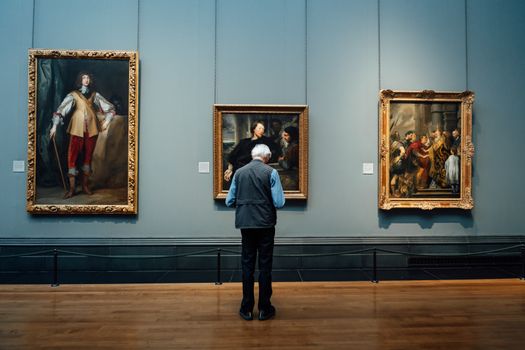
An elderly man admires classic paintings at an art gallery in England. Indoor lighting enhances the historic ambiance. Photo: Miguel González / Pexels
Beyond technical prowess and a commitment to realism, Renaissance art was deeply invested in conveying narrative, emotion, and complex symbolism, often within meticulously balanced compositions. While the medieval period used symbolism extensively, Renaissance artists integrated it more subtly into naturalistic settings, making it accessible to a wider audience while still retaining layers of meaning for the initiated. Every detail, from the type of flower in a foreground to the gesture of a hand, could carry symbolic weight, enriching the viewer's understanding of the depicted scene. For instance, in many Annunciation scenes, a white lily often symbolizes the purity of the Virgin Mary, while a book might represent the fulfillment of prophecy. The composition of Renaissance paintings and sculptures was often characterized by a profound sense of order, balance, and harmony, reflecting the classical ideals of beauty and proportion. Artists frequently employed geometric principles, such as the golden ratio and triangular compositions, to create stable and aesthetically pleasing arrangements. Raphael's 'School of Athens' is a prime example, with its perfectly balanced architecture and figures, guiding the viewer's eye through a complex philosophical dialogue. This sense of order was not merely aesthetic; it also reflected a belief in the inherent order and rationality of the universe, a concept central to humanist thought. Emotion played a crucial role, moving beyond the stylized expressions of earlier periods to convey a wide range of human feelings with unprecedented psychological depth. Artists sought to capture the inner lives of their subjects, making their pain, joy, devotion, or contemplation palpable to the viewer. The dramatic intensity of Michelangelo's 'Pietà,' where Mary cradles the lifeless body of Christ, evokes profound sorrow and compassion, rendered with a moving tenderness. This empathetic connection between art and viewer was a hallmark of the Renaissance, aiming to engage not just the intellect but also the heart. The narrative power of Renaissance art was immense. Whether depicting biblical stories, classical myths, or historical events, artists sought to tell these tales with clarity, drama, and emotional impact. They carefully arranged figures, used gestures, and manipulated light to guide the viewer through the story, making it feel immediate and engaging. The use of continuous narrative, where multiple scenes from a story are depicted within a single frame, was also employed to enhance storytelling. The integration of landscape elements also became more sophisticated, moving beyond mere backdrops to become atmospheric components that contributed to the mood and meaning of the work. The landscapes in works by artists like Giovanni Bellini often evoke a serene and harmonious natural world, reflecting a sense of divine presence or human tranquility. This comprehensive approach to composition, symbolism, and emotion allowed Renaissance art to communicate profound ideas and feelings, making it a powerful force in shaping cultural identity and spiritual understanding. For those interested in the broader impact of artistic movements, exploring the evolution of artistic narratives can provide further context.

Common Misconceptions and Key Takeaways in Renaissance Art Appreciation
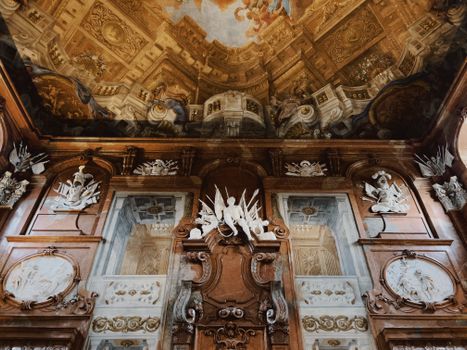
A detailed view of a Baroque interior with intricate ceiling art and sculptures. Photo: Mehmet Turgut Kirkgoz / Pexels
Understanding the core characteristics of Renaissance art can sometimes be complicated by common misconceptions. Dispelling these myths is crucial for a more accurate appreciation of this pivotal period. Here are some key points to consider and common pitfalls to avoid: * **Myth 1: Renaissance art completely abandoned religion.** While humanism emphasized human potential, it rarely rejected spirituality. Most Renaissance art was still religiously themed, but it presented religious figures and stories with a new humanistic lens, making them more relatable and psychologically complex. The divine was often celebrated through the perfection of the human form and the beauty of the natural world, seen as God's creation. * **Myth 2: It was a sudden, unified movement across Europe.** The Renaissance started in Florence, Italy, and spread gradually. Different regions and cities developed their own distinct styles and interpretations, leading to variations like the Venetian Renaissance (known for color and light) versus the Florentine Renaissance (known for drawing and sculpture). It was a progressive evolution, not an instantaneous revolution. * **Myth 3: All Renaissance art looks the same.** While there are overarching characteristics, the styles of individual artists like Botticelli, Leonardo, Michelangelo, and Raphael are distinct. Botticelli's lyrical lines and allegorical themes differ significantly from Michelangelo's powerful, sculptural forms or Leonardo's sfumato and scientific precision. Recognizing these individual artistic voices enriches the viewing experience. * **Myth 4: It was solely about technical perfection.** While technical mastery (perspective, anatomy) was paramount, it served a higher purpose: to convey meaning, emotion, and narrative more effectively. The techniques were tools to express humanist ideals and tell stories with greater impact, not ends in themselves. **Key Takeaways for Appreciation:** * **Focus on the human element:** Look for how human figures are depicted – their expressions, gestures, and anatomical accuracy. This reflects the humanist shift. * **Observe spatial illusion:** Pay attention to how artists create depth and distance using linear perspective. Can you identify vanishing points and orthogonal lines? * **Analyze light and shadow:** Notice the use of chiaroscuro and sfumato to model forms and create dramatic effects. How does light guide your eye or create mood? * **Consider the narrative:** What story is being told? How do the composition, figures, and symbols contribute to the message? * **Recognize classical influence:** Look for architectural elements, mythological themes, or poses (like contrapposto) that hark back to ancient Greece and Rome. By understanding these nuances and focusing on these key aspects, viewers can move beyond superficial observation to a deeper, more informed appreciation of the profound innovations and enduring legacy of Renaissance art.

Comparison

CharacteristicRenaissance ArtMedieval ArtBaroque Art
Dominant PhilosophyHumanism, Classical RevivalTheocentric, SpiritualCounter-Reformation, Drama
PerspectiveLinear Perspective (Mathematical)Symbolic, FlatDramatic, Illusionistic
Human FormIdealized, Anatomically AccurateStylized, SymbolicEmotional, Dynamic, Theatrical
CompositionBalanced, Harmonious, SymmetricalHierarchical, StaticAsymmetrical, Energetic, Diagonal
EmotionSubtle, Reflective, PsychologicalLimited, IconicIntense, Exaggerated, Grandiose
Light & ShadowChiaroscuro, SfumatoFlat LightingDramatic Tenebrism
Primary Subject MatterReligious, Mythological, PortraitureReligious, DidacticReligious, Mythological, Historical

What Readers Say

"This article beautifully explained the core renaissance art characteristics. I finally understand the difference between chiaroscuro and sfumato, and how humanism shaped the entire movement. Truly insightful!"

Sophia G. · New York, NY

"As an art history student, this piece offered a comprehensive and accessible breakdown of renaissance art principles. The detailed explanations of linear perspective and anatomical accuracy were particularly helpful for my studies."

Ethan K. · Los Angeles, CA

"I always found Renaissance art intimidating, but this article made renaissance art characteristics explained so clearly. Now, when I visit museums, I can actually identify and appreciate the nuances in the masterpieces."

Olivia P. · Chicago, IL

"A very thorough explanation, though I wish there were more direct examples of specific artworks for each characteristic discussed. Still, it's an excellent resource for anyone wanting to grasp the fundamentals."

Noah R. · Houston, TX

"Even as a casual art enthusiast, this article provided such a rich understanding of the techniques and philosophy behind Renaissance art. It truly deepens the appreciation of these timeless works."

Isabella M. · Miami, FL

Frequently Asked Questions

What are the three main characteristics of Renaissance art?

The three main characteristics are Humanism (focus on human potential and achievement), Realism/Naturalism (accurate depiction of the natural world and human anatomy), and the innovative use of Perspective (especially linear perspective to create depth).

Is Renaissance art still relevant today?

Absolutely. Renaissance art's emphasis on human potential, scientific inquiry, and aesthetic principles continues to influence modern art, design, and even scientific thought. Its techniques for realism and perspective remain foundational in visual arts.

How did linear perspective change art?

Linear perspective revolutionized art by providing a mathematical system to create the illusion of three-dimensional space on a flat surface. It allowed artists to depict depth, distance, and proportional relationships accurately, making scenes appear more realistic and immersive.

What is the economic value of a Renaissance masterpiece today?

Renaissance masterpieces are among the most valuable artworks in the world, often fetching tens to hundreds of millions of dollars at auction, if they ever become available. Their historical significance, rarity, and artistic mastery contribute to their immense value.

How does Renaissance art compare to Baroque art?

While Renaissance art emphasizes harmony, balance, and rational order, Baroque art (which followed) often features dramatic motion, intense emotion, grandeur, and heightened realism, often with strong chiaroscuro and theatrical compositions, reflecting the Counter-Reformation.

Who should learn about renaissance art characteristics explained?

Anyone interested in art history, cultural studies, philosophy, or simply appreciating beauty will benefit. Students, museum-goers, artists, and general enthusiasts can all gain a deeper understanding of Western civilization's artistic heritage.

Are there any risks in misinterpreting Renaissance art?

Misinterpreting Renaissance art can lead to overlooking its complex layers of symbolism, its humanist philosophy, or its technical innovations. Understanding the historical context and artistic principles helps avoid anachronistic judgments or superficial appreciation.

What are the future trends in studying Renaissance art?

Future trends involve using digital humanities, 3D scanning, and AI to analyze artworks, reconstruct historical contexts, and make masterpieces accessible globally. There's also a growing focus on previously marginalized artists and patrons of the period.

By delving into the core renaissance art characteristics explained here, you've gained a profound understanding of an era that redefined human creativity. Continue your journey of discovery and let the masterpieces of the Renaissance inspire your own appreciation for art's enduring power.

Topics: renaissance art characteristics explainedrenaissance art principleshumanism in artlinear perspectiverenaissance artistic techniques
Leo List

IE Escorts NO Escorts US Escorts NZ Escorts AU Escorts
Brampton weed
Adultwork EstrelaBet Vai de Bet R7 Bet Betão Galera Bet Rainbet Bet9ja Shop SportyBet BetKing Sisal Loto Foot Hollywoodbets YesPlay Odibets RushBet Jugabet BetWarrior BetCity MSport betPawa Fortebet